

Co-Hosting in Carlsbad: How It Works and What to Expect

Updated: May 6

Co-hosting Carlsbad properties is a management arrangement where a local professional handles the day-to-day operations of your short-term rental while you retain ownership of the listing and ultimate control over your property. Co-hosting Carlsbad vacation rentals means the co-host handles guest communication, cleaning coordination, check-ins, and pricing, while you collect the majority of each booking's revenue. According to AirDNA, Carlsbad's short-term rental market averaged $42,300 in annual revenue per listing in 2026, with an occupancy rate of 61% and an average daily rate of $410.70. For property owners in this market, choosing the right co-hosting Carlsbad arrangement is one of the most consequential decisions you will make.
Co-hosting Carlsbad properties is not the same as full property management: you keep your listing, your brand, and direct platform accountability, while the co-host operates under your account.
Co-host fees in Carlsbad typically range from 10 to 18% of gross booking revenue, compared to 20 to 30% for full-service property managers.
Carlsbad draws approximately 4 million visitors per year (Visit Carlsbad), making it one of San Diego County's top tourism markets with strong year-round STR demand.
Airbnb's Co-Host Network lists three active Carlsbad co-hosts with guest ratings between 4.91 and 4.97, but the platform is one of several ways to find a qualified local co-host for co-hosting Carlsbad rentals.
Vetting matters more than price: the cheapest co-host in a high-demand market often costs more in lost revenue and bad reviews than a premium professional partner would.
Carlsbad's STR Regulation score is 63 out of 100 per AirDNA, meaning moderate regulatory complexity; your co-host must understand the City of Carlsbad's Transient Occupancy Tax rules and permit requirements.
What Exactly Is Co-Hosting and How Does It Differ from Full Management?
Co-hosting Carlsbad rentals is a collaborative short-term rental arrangement where a property owner partners with an experienced local operator to manage guest-facing tasks, without transferring ownership or control of the listing. The key structural distinction: in a co-hosting arrangement, your Airbnb or VRBO account remains the primary listing account. Your name, your reviews, and your Superhost status are all yours. The co-host is added as an authorized operator under your account. In a full management model, the management company often creates and owns the listing itself, meaning you lose your review history if you part ways.
A Carlsbad co-host typically handles: guest inquiries and booking approvals, check-in logistics, mid-stay communication, checkout inspections, cleaning vendor coordination, and maintenance scheduling. For the Carlsbad market, where 87% of STR listings are entire-home rentals according to AirDNA, co-hosts are most commonly hired for properties in Carlsbad Village, La Costa, and coastal neighborhoods near the beach. For more on what an Airbnb co-host does and how the role works, The Brite Place has a dedicated breakdown worth reviewing.
At The Brite Place, we position co-hosting as the right solution for owners who want professional operational support but prefer to stay involved in pricing decisions and listing strategy. It is a partnership model, not a handoff. For a detailed comparison of the revenue implications, the co-hosting vs self management ROI data from San Diego STRs breaks down the financial difference with real numbers.

How Much Does a Co-Host Get Paid in Carlsbad?
Co-host compensation in Carlsbad is structured as a percentage of gross booking revenue, typically falling between 10% and 18% depending on the scope of services included. For example, a co-host managing a property that earns $3,500 per month would receive between $350 and $630 monthly under this model. Some co-hosts charge a flat monthly fee instead, generally ranging from $200 to $500 for limited-service arrangements covering only guest communication and key handover. Understanding property manager cost structures and how fees are calculated can help you benchmark any co-host proposal you receive.
The percentage varies by service scope. A co-host who only manages guest messaging might charge 10 to 12%. One who also coordinates cleaning, handles maintenance calls, manages restocking, and provides onsite support typically charges 15 to 18%. For context, full-service property managers in Carlsbad charge 20 to 30% and also manage the listing account itself.
Three named co-hosts appear on Airbnb's Co-Host Network for Carlsbad: Amber, Judy, and Jonathan Love of Love Living, with guest ratings of 4.94, 4.97, and 4.91 respectively. These are Airbnb platform ratings, not independent verified figures. Independent co-hosting professionals and management companies like The Brite Place often operate outside the Airbnb marketplace, so comparing platform-listed co-hosts to full-service operators requires evaluating their specific service scope and pricing transparency side by side.
Co-Host Service Level | Typical Fee Range | What's Included |
Basic (communications only) | 10 to 12% of gross revenue | Guest messaging, booking approvals, check-in instructions |
Mid-Level (operations) | 13 to 15% of gross revenue | Above plus cleaning coordination, key handover, supply restocking |
Full Co-Host (all-in) | 15 to 18% of gross revenue | Above plus maintenance scheduling, pricing input, review management |
Full-Service Management | 20 to 30% of gross revenue | All above plus listing ownership, dynamic pricing, regulatory compliance, financial reporting |
What Is the 75-55 Rule for Airbnb Co-Hosting?
The 75-55 rule for Airbnb co-hosting is an informal revenue-split benchmark that describes how payouts can be structured when multiple parties are involved in hosting. It suggests the primary host (listing owner) retains 75% of booking revenue, while the co-host receives 25%, which is then further split so the co-host keeps 55% of their share and allocates the remaining 45% to cleaning, supplies, and operational costs. The result is that the co-host's net take after expenses is closer to 13 to 15% of gross, which aligns with the mid-level fee range seen in practice.
This rule is not an Airbnb official policy. It is a practitioner shorthand used in hosting communities as a starting-point negotiation framework. In Carlsbad's higher-ADR market, where properties average $410.70 per night, even a 13% co-host fee on a well-occupied property represents meaningful income, which is why experienced local co-hosts in North County San Diego are selective about which properties they accept.
For your purposes as a property owner, the 75-55 rule is less important than the actual written agreement you sign. What matters: is the percentage applied to gross revenue before cleaning fees, or net after platform fees? That distinction alone can shift your effective cost by 2 to 3 percentage points. For a full breakdown of what different management arrangements cost owners, see What Do Property Management Companies Charge: Full Fee Breakdown.
What Is the 80/20 Rule for Airbnb?
The 80/20 rule for Airbnb refers to the principle that roughly 80% of a host's revenue typically comes from 20% of their calendar, specifically peak weekends, holiday windows, and high-demand event dates. In Carlsbad, those demand spikes align with predictable annual patterns: the Carlsbad Flower Fields bloom season from March through May, LEGOLAND seasonal events, summer beachfront demand (hotel occupancy hit 88.5% in July and 84.3% in August during recent peak periods per Carlsbad.org), and major surf competitions and holiday weekends.
A skilled co-host uses this framework to prioritize pricing aggressively during the 20% of nights that drive the majority of annual income. For example, a property earning $42,300 annually does not earn $3,525 evenly each month. It likely earns $6,000 to $8,000 in July and August and $2,000 to $3,000 in January. Co-hosts who understand the 80/20 dynamic in Carlsbad will push nightly rates significantly higher during Flower Fields weekends and summer peak weeks rather than averaging them into a flat rate.
This is where co-host performance diverges sharply. A co-host who sets-and-forgets your pricing misses the upside from those peak demand windows. Vacation Rental Dynamic Pricing: How One Big Bear Cabin Earned 340% More illustrates precisely how much revenue dynamic rate management can unlock compared to flat or Smart Pricing approaches. The vacation rental dynamic pricing guide explains why manual rate-setting is one of the most common and costly mistakes Carlsbad property owners make.

What Are the Drawbacks of Using a Co-Host?
Co-hosting drawbacks are real and worth understanding before you sign an agreement. First, accountability is divided. If a guest leaves a negative review because check-in instructions were unclear, the impact falls on your listing, your Superhost status, and your long-term booking visibility, not the co-host's. The co-host faces no platform-level consequence for operational failures in the same way you do.
Second, co-hosting arrangements vary widely in professionalism. Unlike licensed property managers, Airbnb-network co-hosts in Carlsbad are not required to hold a California real estate broker's license, carry errors and omissions insurance, or meet any regulatory standard. Anyone can list themselves as a co-host. This is why the vetting process described in the next section matters so much.
Additionally, co-hosts typically do not manage dynamic pricing with the same sophistication as full-service operators. Most basic and mid-level co-hosts rely on your existing pricing settings or Airbnb's Smart Pricing tool, which industry data consistently shows underprices Carlsbad properties during peak demand windows. If revenue optimization is your primary goal, a full-service management partner or a co-host who specifically offers dynamic pricing as part of their scope will outperform a communications-only co-host significantly.
Finally, insurance and liability deserve attention. Most co-hosts are not covered by your homeowner's policy when acting as a service contractor. Airbnb's AirCover provides some guest-damage protection, but it does not cover co-host negligence or third-party contractor errors. Clarify insurance coverage in writing before finalizing any co-host agreement. There are also hidden costs short-term rental management San Diego companies won't tell you about that can erode your net returns if you are not watching for them. For an objective look at whether full management makes more financial sense for your property, the 2026 reality check on whether property management is worth it offers a useful framework.
How Do You Vet and Interview a Co-Host in Carlsbad?
Vetting a co-host for your co-hosting Carlsbad arrangement requires a structured process because the market includes both highly qualified professionals and informal operators who have never managed a high-demand coastal property. Start by requesting verifiable references from at least three current or past property owners they co-host for, specifically in North County San Diego. Online platform ratings alone are insufficient. A co-host with a 4.94 Airbnb guest rating may still have weak systems for maintenance emergencies or pricing adjustments.
Ask these specific questions in your first interview:
What property management software do you use? Professional co-hosts in 2026 use tools like Guesty, Hostaway, or Lodgify for calendar synchronization, automated messaging, and booking management. Manual spreadsheet-based operations are a red flag for anyone managing more than one or two properties.
How do you handle a maintenance emergency at 2 AM? You want a specific answer: a named vendor or in-house maintenance team, a documented escalation process, and a clear expectation about owner notification timing.
Do you carry liability insurance for your co-hosting activities? Many do not. Acceptable answers include professional liability coverage, an umbrella policy, or a formal business structure with general liability insurance.
How do you manage pricing during peak Carlsbad demand periods? Listen for specific references to the Flower Fields season, summer beach demand, and LEGOLAND event weekends. Generic answers about dynamic pricing tools without local context signal a lack of market knowledge.
What is your response time standard for guest messages? Airbnb's Superhost qualification requires a 90% or higher response rate. Ask how they track and maintain compliance with platform performance thresholds.
At The Brite Place, our co-host vetting framework includes reviewing the candidate's current portfolio size, their cleaning vendor relationships, and their documented process for handling guest disputes. In practice, we have seen Carlsbad owners lose Superhost status within two booking cycles after partnering with an unvetted co-host whose response rate dropped below 85% during a high-volume summer weekend. A co-host who cannot clearly describe their dispute resolution approach will cost you 5-star reviews, and Carlsbad Airbnb listings lose search ranking measurably when review averages drop below 4.8.
What Should a Co-Host Agreement Include?
A co-host agreement is a written contract between you and your co-host that defines the scope of services, compensation structure, and each party's responsibilities for operating your Carlsbad short-term rental. Every co-hosting agreement should cover these elements at minimum:
Scope of services: List every task explicitly. Guest communication, cleaning coordination, key handover, maintenance scheduling, supply restocking, and pricing management should each be either included or excluded in writing. Ambiguity here is where most co-hosting disputes originate.
Compensation terms: Specify the exact percentage or flat fee, what revenue base the fee is applied to (gross booking value or net after Airbnb service fees), and the payment schedule.
Expense authority: Define the spending threshold below which your co-host can authorize maintenance or supply purchases without your approval. A standard owner reserve of $200 to $500 is common, above which co-hosts must seek approval before committing funds.
Listing control: Confirm in writing that the listing remains under your account, your name, and your ownership. Include provisions for what happens to review history if the arrangement ends.
Termination terms: Specify notice requirements for either party to end the agreement. Thirty days is standard; less than two weeks is a red flag that the co-host expects high turnover.
Insurance and liability: Document each party's insurance coverage and establish who bears responsibility for damages not covered by Airbnb's AirCover.
Reporting requirements: Specify how often you receive booking reports, financial summaries, and property condition updates.
California does not require co-hosts to hold a real estate broker license the way full property managers do, but if your co-host is negotiating lease terms or collecting rent on your behalf as part of a longer-term or mid-term rental arrangement, California's Department of Real Estate licensing rules may apply. Clarify this with a California real estate attorney if your strategy involves mid-term rentals alongside short-term stays. Understanding the full distinction between these roles is covered in depth in Property Manager vs Cohost: What Every Owner Needs to Know in 2026.

Co-Hosting vs Full Property Management vs Self-Hosting: Which Is Right for You?
Co-hosting Carlsbad rentals, full property management, and self-hosting represent three distinct operational models for Carlsbad short-term rental owners, each with different cost structures, control levels, and revenue outcomes. Understanding where each model fits your situation is the most practical decision framework available.
Factor | Self-Hosting | Co-Hosting | Full Property Management |
Owner Time Required | 10 to 20 hrs/week | 2 to 5 hrs/week | Under 1 hr/week |
Management Cost | 0% (your time only) | 10 to 18% of gross revenue | 20 to 30% of gross revenue |
Listing Ownership | Owner | Owner | Often the manager |
Dynamic Pricing | Owner-managed | Varies by co-host | Typically included |
24/7 Guest Support | Owner responsible | Usually included | Always included |
Regulatory Compliance | Owner responsible | Partial support | Fully managed |
Revenue Potential | Moderate (limited pricing tools) | Moderate to high | Highest with professional pricing |
Co-hosting Carlsbad properties is the right fit when you are local enough to stay involved in strategic decisions, comfortable retaining listing accountability, and primarily need operational help rather than full oversight. Full property management makes more sense if you are an absentee owner, manage multiple properties, or want completely hands-off income with professional dynamic pricing. AirDNA data indicates that professional STR management typically delivers 20 to 40% higher annual revenue than self-management, primarily through dynamic pricing and occupancy optimization. If you are still deciding whether professional help is warranted at all, Do I Need a Property Manager to Rent My Home in 2026? walks through the key decision factors. For property owners in Carlsbad, where the hidden costs of property management in Carlsbad can affect net returns significantly, running the full cost comparison before deciding is essential.
What Co-Hosting Platforms and Services Are Available in Carlsbad?
Co-hosting Carlsbad services are available through several distinct channels, each suited to different owner needs and involvement levels. The Airbnb Co-Host Network is the most visible option, listing three Carlsbad-based co-hosts directly on the platform with guest ratings and service descriptions. Airbnb's network allows you to review co-host profiles, check ratings, and initiate contact directly within the platform at airbnb.com/co-host.
Beyond the Airbnb marketplace, Carlsbad property owners can work with local full-service management companies that offer co-hosting as a structured service tier. Grand Welcome of Carlsbad, operated by the Kinaya family, holds 5-star Google ratings and both Airbnb Superhost and Vrbo Premier Host status, distributing properties across Airbnb, VRBO, and 30 or more travel websites. Their service area covers Carlsbad, La Costa, Oceanside, and Encinitas. You can find them by searching Grand Welcome Carlsbad directly on Google. West Coast Homestays takes a hybrid approach, offering both short-term and mid-term rental management for corporate clients including government contractors and naval personnel, which maintains occupancy during slower leisure travel windows. Search West Coast Homestays San Diego to locate their current contact information.
For owners who want multi-platform distribution beyond Airbnb and VRBO, full-service operators typically list on Google Vacation Rentals, Houfy, and direct booking websites as well. According to AirDNA, 54% of Carlsbad STR listings distribute across both Airbnb and VRBO simultaneously, while 38% are Airbnb-only and 8% are VRBO-only. A co-host who only manages your Airbnb account leaves meaningful booking volume on the table from VRBO's audience, which skews toward families and longer-stay guests, an important segment in Carlsbad given the city's family tourism profile around LEGOLAND. Owners in neighboring communities can also find useful context in the Property Management In Encinitas Ca Complete Guide For 2026, which covers similar coastal market dynamics just to the south.
The co-hosting resources for Carlsbad property owners on The Brite Place's site provide additional context on selecting between these service models for North County San Diego properties.
How Do You Measure Co-Host Performance and ROI?
Co-host performance measurement refers to the systematic tracking of key short-term rental metrics to evaluate whether your co-hosting Carlsbad arrangement is generating the revenue and guest satisfaction results your property is capable of achieving. Without a defined measurement framework, most property owners cannot tell whether their co-host is optimizing performance or simply maintaining baseline operations.
Track these five metrics monthly at minimum:
Occupancy rate: Carlsbad's market average is 61% per AirDNA. If your property consistently falls below the market rate after accounting for intentional blackout dates, your co-host's booking management or pricing may be underperforming.
Average daily rate (ADR): Carlsbad's market ADR is $410.70. Your specific ADR should reflect your property's size, location, and amenities, but consistent underperformance against comparable listings signals pricing problems.
Revenue per Available Rental (RevPAR): This single metric combines occupancy and ADR. Carlsbad's market RevPAR is $248.80. Track your RevPAR monthly and compare it to the market benchmark.
Review score trend: Superhost qualification requires a 4.8-star minimum. If your review average is declining or stagnant below 4.8, guest experience issues likely trace back to cleaning quality, communication delays, or maintenance responsiveness.
Response rate: Airbnb measures this for Superhost qualification at 90% or higher. Your co-host should maintain this rate consistently, and you can verify it in your Airbnb host dashboard at any time.
Request monthly performance reports from your co-host that include all five metrics. Any co-host who resists providing transparent reporting, or who cannot explain month-over-month variances, is not managing your investment with the professionalism Carlsbad's competitive market demands. Tracking broader San Diego rental market trends investors are watching in 2026 can also help you contextualize your property's performance against the wider regional picture.
What Insurance and Legal Considerations Apply to Co-Hosting?
Co-hosting insurance and legal considerations in Carlsbad involve several overlapping coverage areas that many property owners and co-hosts fail to address explicitly before starting operations. Your standard homeowner's insurance policy almost certainly excludes commercial short-term rental activity. You need a specific short-term rental insurance policy or a rider from a carrier like Proper Insurance or CBIZ, which covers STR-specific risks including guest liability, property damage beyond Airbnb's AirCover, and loss of rental income.
Airbnb's AirCover for Hosts provides up to $3 million in property damage protection and $1 million in liability coverage per booking. However, AirCover does not cover co-host negligence, contractor damage during maintenance visits, or liability arising from the co-host's independent actions on your property. If your co-host arranges a repair that causes water damage, AirCover is not the remedy. Your STR insurance policy or the co-host's own general liability coverage would apply.
On the regulatory side, the City of Carlsbad collects a Transient Occupancy Tax (TOT) from short-term rental guests, and the city projected $16 million in TOT revenue in one fiscal year according to Carlsbad.org. As the listing owner, you are responsible for TOT compliance regardless of whether a co-host handles the operational side. Ensure your co-host either collects and remits TOT correctly or confirms that Airbnb and VRBO's automated collection handles it for your specific listing structure.
Carlsbad's STR Regulation score of 63 out of 100 per AirDNA reflects moderate regulatory complexity. Operating without required permits can result in fines of $500 to $5,000 per violation per California STR ordinance standards. Your co-hosting agreement should clearly assign responsibility for permit maintenance and regulatory compliance. The San Diego Good Neighbor Policy compliance guide covers the broader regulatory framework affecting Carlsbad-area STR operators in 2026. For a complete overview of all rules affecting San Diego area short-term rentals, San Diego STR Regulations 2026: Complete Guide For Property Owners is an essential reference.
What Technology Tools Should Your Co-Host Be Using?
Technology tools for co-hosting Carlsbad properties refer to the software platforms and automation systems that professional short-term rental operators use to manage bookings, guest communication, pricing, and operations across multiple properties efficiently. In 2026, the use of property management software is not optional for any co-host managing more than two properties in a competitive market like Carlsbad.
At minimum, your co-host should operate with:
A property management system (PMS): Tools like Guesty (guesty.com), Hostaway (hostaway.com), or Lodgify (lodgify.com) synchronize calendars across Airbnb, VRBO, and direct booking channels to prevent double bookings, automate guest messaging sequences, and centralize financial reporting.
Dynamic pricing software: PriceLabs (pricelabs.co), Wheelhouse (usewheelhouse.com), or Beyond Pricing analyze real-time Carlsbad market demand, competitor rates, and local event calendars to adjust your nightly rate daily. A co-host using Airbnb's built-in Smart Pricing alone is leaving money on the table during peak demand windows: internal data from The Brite Place's managed properties shows a 12 to 19% ADR uplift after switching from Smart Pricing to PriceLabs during Flower Fields season.
Digital lock and keyless entry systems: Automated check-in via smart locks eliminates the single largest source of guest complaints in coastal markets: arrival friction. Systems like Schlage Encode or Igloohome generate unique codes per booking that expire automatically at checkout.
Cleaning management tools: Platforms like Properly (getproperly.com) or Breezeway (breezeway.io) allow co-hosts to assign, track, and verify cleaning tasks with photo documentation, ensuring turnover quality is consistent across every booking.
Ask any prospective co-host specifically which tools they use and how those tools connect to your owner reporting. You should expect a real-time dashboard showing booking revenue, occupancy trends, and maintenance requests. Co-hosts who cannot provide this are operating below the standard that Carlsbad's professional STR market now expects. For a broader look at what San Diego area property management companies offer in terms of technology and service depth, the guide to the best Airbnb management companies in San Diego provides a useful comparison framework.
Frequently Asked Questions About Co-Hosting in Carlsbad
How does co-hosting in Carlsbad differ from hiring a traditional property manager?
Co-hosting Carlsbad properties differs from traditional property management primarily in who owns and controls the listing. In a co-hosting arrangement, you retain the Airbnb or VRBO listing account, your review history, and your Superhost status. A traditional property manager often takes ownership of the listing. Co-hosting fees are also lower, typically 10 to 18% of gross revenue versus 20 to 30% for full-service management, but co-hosts generally provide less comprehensive services, particularly around regulatory compliance and dynamic pricing.
Does Carlsbad require a permit to operate a short-term rental?
Yes, the City of Carlsbad has Transient Occupancy Tax (TOT) requirements that apply to all short-term rental operators. The city projected $16 million in TOT revenue in one fiscal year, indicating active collection and enforcement. Carlsbad's STR Regulation score is 63 out of 100 per AirDNA, reflecting moderate regulatory complexity. You should verify current permit and registration requirements directly with the City of Carlsbad's Finance Department, as local STR ordinances can change. Operating without required permits can result in fines of $500 to $5,000 per violation.
Can a co-host help me achieve Airbnb Superhost status?
A skilled co-host can directly support Superhost qualification by maintaining the required 90% or higher response rate, keeping your cancellation rate at 1% or lower, and ensuring guest satisfaction scores stay at or above the 4.8-star threshold. Since Superhost status is tied to your listing account rather than the co-host's, the operational quality your co-host delivers directly impacts your platform standing and, by extension, your search visibility and booking conversion rate on Airbnb.
What is the typical co-hosting commission structure in Carlsbad?
Co-hosting commissions in Carlsbad typically range from 10 to 18% of gross booking revenue, depending on the scope of services included. Basic communication-only arrangements start around 10 to 12%, while full-scope co-hosting covering cleaning coordination, maintenance, onsite support, and pricing management reaches 15 to 18%. Flat fee structures also exist for limited-service arrangements, typically ranging from $200 to $500 per month. Always clarify whether the percentage is calculated on gross booking value or net after platform fees, as this distinction meaningfully affects your effective cost.
How many short-term rentals are active in Carlsbad?
According to AirDNA data from 2026, Carlsbad had 1,271 active short-term rental listings, with active listings growing 8% in the prior 12 months. Of those listings, 87% are entire-home rentals and 52% are available 271 to 365 nights per year, indicating a predominantly professional hosting base rather than occasional casual hosts. The market is competitive, which makes the quality of your co-hosting Carlsbad arrangement a direct driver of your competitive positioning.
What should I watch for as red flags when choosing a Carlsbad co-host?
Key red flags when evaluating a Carlsbad co-host include: no written agreement or resistance to formalizing terms, inability to name their maintenance vendor network, no use of property management software for calendar synchronization, lack of verifiable references from current property owners in North County San Diego, and vague answers about how they handle guest disputes or emergency maintenance. Co-hosts who cannot explain their pricing approach beyond Airbnb's built-in Smart Pricing are also a concern in a high-ADR market like Carlsbad.
How does Carlsbad's tourism seasonality affect co-hosting strategy?
Carlsbad's tourism pattern shows strong peak demand from mid-June through August, with hotel occupancy reaching 88.5% in July and 84.3% in August per Carlsbad.org. Secondary demand spikes occur during the Flower Fields bloom season from March through May and around LEGOLAND event weekends. Carlsbad draws approximately 4 million visitors per year, with the city ranking as San Diego County's second-highest tourism generator. A knowledgeable co-host uses these demand windows to push nightly rates significantly above the annual average daily rate of $410.70, rather than maintaining flat pricing year-round.
Is Co-Hosting the Right Move for Your Carlsbad Property in 2026?
Co-hosting Carlsbad properties is the right operational model for owners who want professional help with day-to-day operations without fully relinquishing listing control or paying full management commissions. The Carlsbad STR market in 2026 remains one of Southern California's strongest performers, with AirDNA rating its Investability score at 82 out of 100 and Rental Demand at 82, reflecting genuine, sustained demand driven by the city's 4 million annual visitors, coastal appeal, and growing business travel segment.
The decision to pursue co-hosting Carlsbad versus self-management versus full-service management should be driven by three factors: your proximity to the property, your tolerance for operational involvement, and your revenue expectations. If you want genuinely passive income with professional dynamic pricing, full management is likely the better fit. If you are local, willing to stay involved in strategic decisions, and primarily need operational backup, co-hosting Carlsbad delivers solid value at a lower cost. Owners of coastal properties in nearby communities may also find the Property Management Pacific Beach: A 2026 Owner's Practical Guide useful for understanding how similar coastal markets approach these same decisions.
What you cannot afford to do is treat the co-host selection as a commodity choice. In a market where Carlsbad STR listings average $410.70 per night and 52% of operators run their properties as professional businesses, the quality of your co-host directly ties to your revenue outcome and your listing's long-term search ranking on Airbnb and VRBO.
Use the vetting framework, the contract checklist, and the performance metrics outlined in this guide to find a co-hosting partner who treats your property with the same standards a professional management company would.
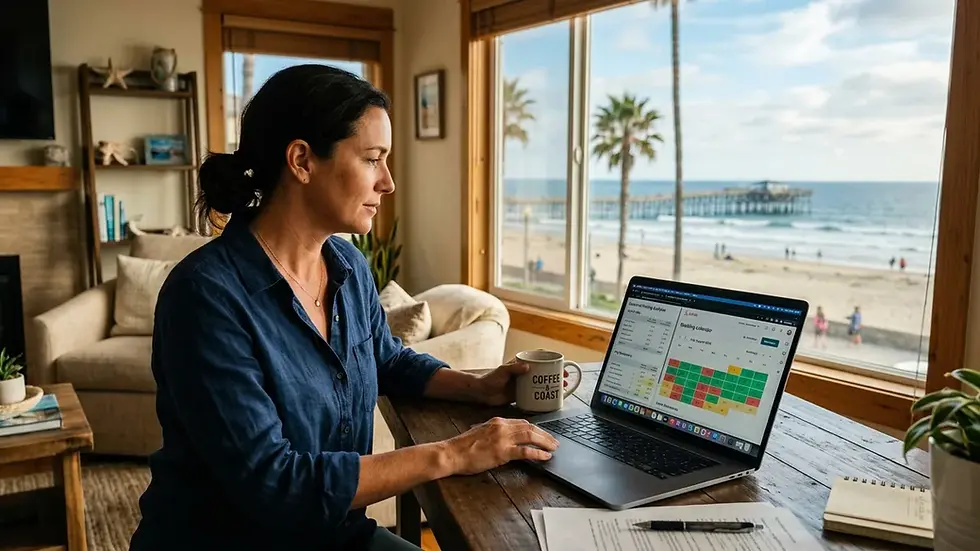
If you are weighing whether co-hosting Carlsbad or full management makes more financial sense for your property, The Brite Place works with property owners across Carlsbad, Encinitas, Oceanside, and greater San Diego County to evaluate their specific situation, compare the actual revenue scenarios, and implement the right management structure. Our Airbnb co-hosting and STR management services are built around what your property actually needs, not a one-size-fits-all commission rate. Reach out to discuss your property and get a clear picture of what professional management could deliver for you in 2026.
Content powered by InkSTR.co


Comments